Home
/ Joining With Noun Clause Examples, Noun Clause What It Is And How To Identify It : Every clause has at least one subject and one verb.
Joining With Noun Clause Examples, Noun Clause What It Is And How To Identify It : Every clause has at least one subject and one verb.
Joining With Noun Clause Examples, Noun Clause What It Is And How To Identify It : Every clause has at least one subject and one verb.. Clauses come in four types: The subordinating conjunctions where or wherever can both be used at the beginning of dependent adverbial clauses to answer the question, where. Argument clauses can appear as subjects, as objects, and as obliques. Jennifer and mai had already put out the fire when the firemen arrive at the dorm. Become comfortable with the concept by reading through this helpful guide!
A noun clause may have you questioning your grammar knowledge. Jun 12, 2021 · below are examples of specific subordinating conjunctions being used to answer each question within an adverbial clause. It can also be joined to other dependent or independent clauses to make a more interesting and complex sentence. Main (or independent), subordinate (or dependent), adjective (or relative), and noun. A compound sentence has at least two independent clauses that have related ideas.
Noun Clauses Improve Your English With Dia from images.squarespace-cdn.com A dependent clauses (or subordinate clause) is one that cannot stand alone as a complete sentence (i.e., it does not express a complete thought). I know who said that. I don't care what the doctors say about caffeine intake. The clause recognize a clause when you find one. The dorm's obsolete wiring melted and started a fire because amy left the iron on. Other characteristics will help you distinguish one type of clause from another. An independent clause is a group of words that contains both a subject and a predicate.it expresses a complete thought and can stand alone as a sentence. Argument clauses can appear as subjects, as objects, and as obliques.
I know who said that.
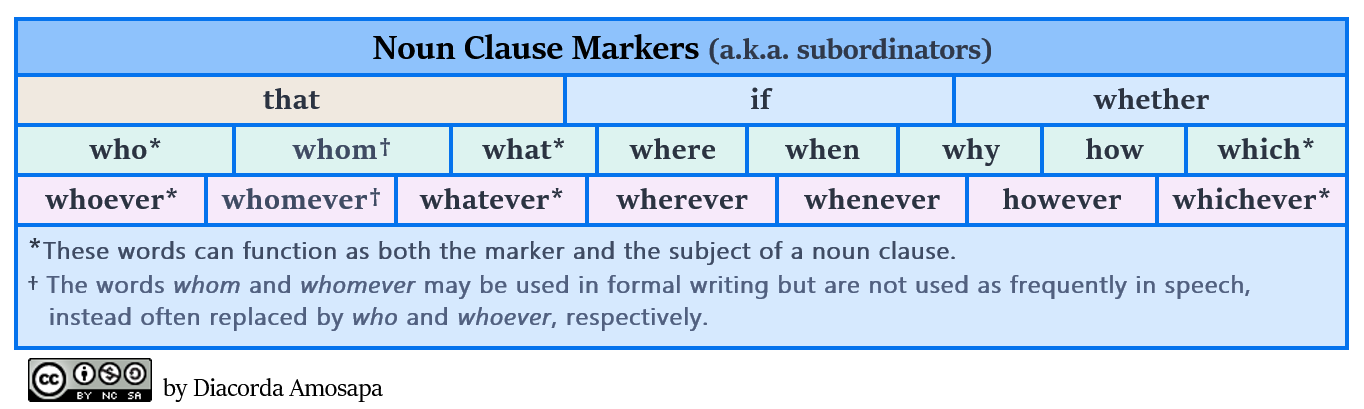
A compound sentence has at least two independent clauses that have related ideas. A noun clause may have you questioning your grammar knowledge. A clause that functions as the argument of a given predicate is known as an argument clause. Main (or independent), subordinate (or dependent), adjective (or relative), and noun. I don't care what the doctors say about caffeine intake. The subordinating conjunctions where or wherever can both be used at the beginning of dependent adverbial clauses to answer the question, where. It can also be joined to other dependent or independent clauses to make a more interesting and complex sentence. The clause recognize a clause when you find one. (with examples) an independent clause is a clause that can stand alone as a sentence (i.e., it expresses a complete thought). Every clause has at least one subject and one verb. Clauses come in four types: The independent clauses can be joined by a coordinating conjunction (for, and, nor, but, or, yet, so) or by a semicolon, as you can see in the compound sentence examples below. Noun clauses can act as either the subject or the object of a clause, and they usually begin with words like what, why, who, and that.
Every clause has at least one subject and one verb. The dependent clause serves as the subject of the main clause.) Argument clauses can appear as subjects, as objects, and as obliques. Every main clause will follow this. I know who said that.
The Noun Clause Worksheet For 6th 8th Grade Lesson Planet from content.lessonplanet.com That they actually helped was really appreciated. Jennifer and mai had already put out the fire when the firemen arrive at the dorm. Every clause has at least one subject and one verb. The dorm's obsolete wiring melted and started a fire because amy left the iron on. Mar 24, 2016 · the adverbial clause, which is a dependent clause, needs the independent clause to form a complete sentence. Other characteristics will help you distinguish one type of clause from another. The clause recognize a clause when you find one. An independent clause is a group of words that contains both a subject and a predicate.it expresses a complete thought and can stand alone as a sentence.
It can also be joined to other dependent or independent clauses to make a more interesting and complex sentence.
Clauses come in four types: A dependent clauses (or subordinate clause) is one that cannot stand alone as a complete sentence (i.e., it does not express a complete thought). Main (or independent), subordinate (or dependent), adjective (or relative), and noun. Every clause has at least one subject and one verb. When you join a dependent clause to an independent clause, you are not joining equals. A clause is a content clause if a pronoun (he, she, it, or they) could be substituted for it. Mar 24, 2016 · the adverbial clause, which is a dependent clause, needs the independent clause to form a complete sentence. The independent clauses can be joined by a coordinating conjunction (for, and, nor, but, or, yet, so) or by a semicolon, as you can see in the compound sentence examples below. It can also be joined to other dependent or independent clauses to make a more interesting and complex sentence. The clause recognize a clause when you find one. Argument clauses can appear as subjects, as objects, and as obliques. A clause that functions as the argument of a given predicate is known as an argument clause. The dependent clause serves as the subject of the main clause.)
Noun clauses can act as either the subject or the object of a clause, and they usually begin with words like what, why, who, and that. A noun clause may have you questioning your grammar knowledge. When you join a dependent clause to an independent clause, you are not joining equals. Other characteristics will help you distinguish one type of clause from another. An independent clause is a group of words that contains both a subject and a predicate.it expresses a complete thought and can stand alone as a sentence.
Ppt Noun Clauses Powerpoint Presentation Free Download Id 7054529 from image3.slideserve.com The independent clauses can be joined by a coordinating conjunction (for, and, nor, but, or, yet, so) or by a semicolon, as you can see in the compound sentence examples below. That they actually helped was really appreciated. The dorm's obsolete wiring melted and started a fire because amy left the iron on. Every clause has at least one subject and one verb. Remember that a clause has a subject and a verb. When you join a dependent clause to an independent clause, you are not joining equals. Clauses come in four types: I don't care what the doctors say about caffeine intake.
They can also modify a noun predicate, in which case they are known as content clauses.
A noun clause may have you questioning your grammar knowledge. Become comfortable with the concept by reading through this helpful guide! Every clause has at least one subject and one verb. Main (or independent), subordinate (or dependent), adjective (or relative), and noun. (with examples) an independent clause is a clause that can stand alone as a sentence (i.e., it expresses a complete thought). The dependent clause serves as the subject of the main clause.) Other characteristics will help you distinguish one type of clause from another. That they actually helped was really appreciated. The independent clauses can be joined by a coordinating conjunction (for, and, nor, but, or, yet, so) or by a semicolon, as you can see in the compound sentence examples below. Every main clause will follow this. The dorm's obsolete wiring melted and started a fire because amy left the iron on. Jennifer and mai had already put out the fire when the firemen arrive at the dorm. An independent clause is a group of words that contains both a subject and a predicate.it expresses a complete thought and can stand alone as a sentence.
It can also be joined to other dependent or independent clauses to make a more interesting and complex sentence noun clause examples. Clauses come in four types: